


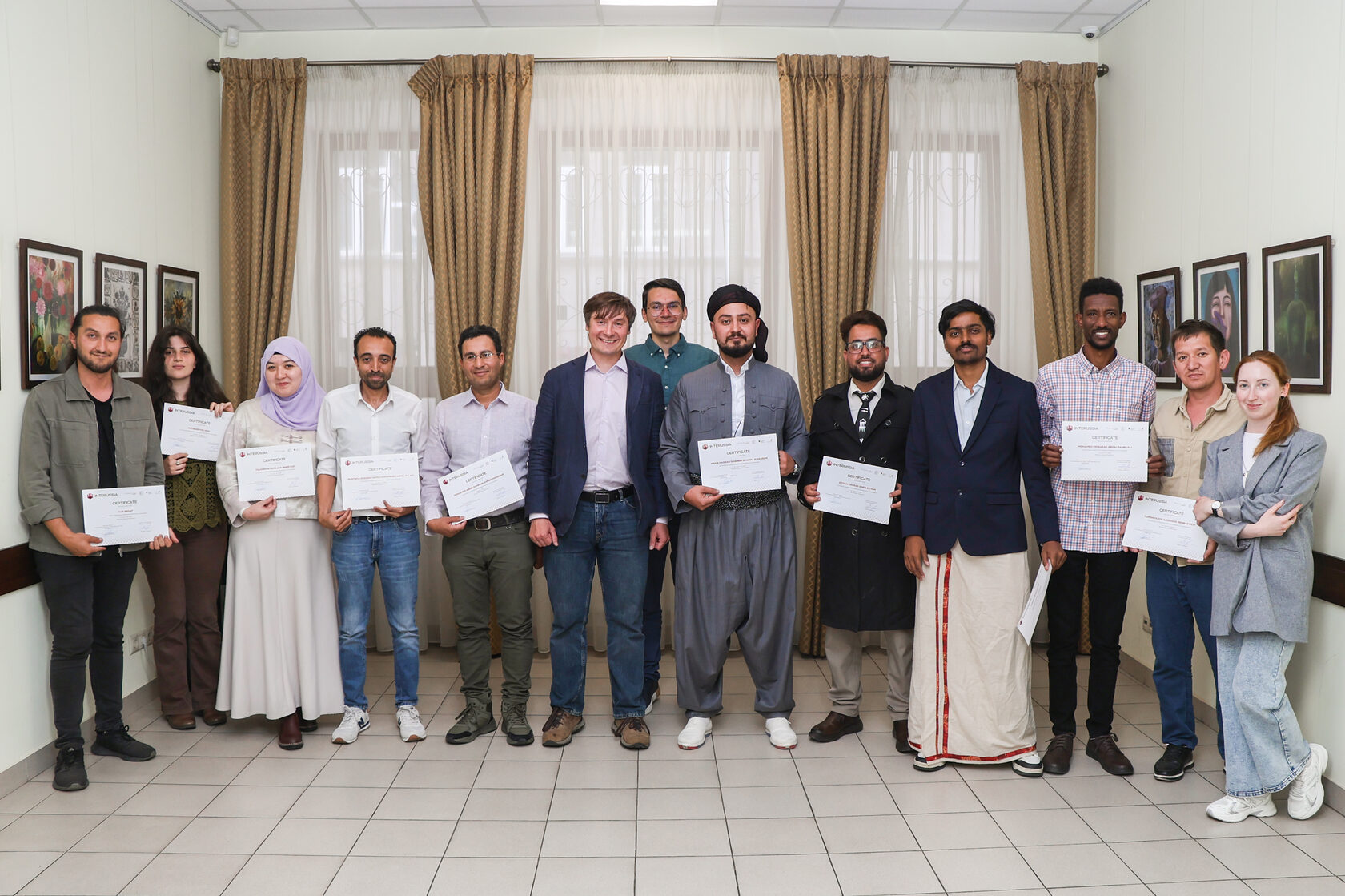
On May 25, the Gorchakov Fund held the closing ceremony of the fellowship for young specialists in archaeology. Among the participants were representatives of Uzbekistan, Georgia, Iraq, Sudan, Egypt, India, and Turkey.
Sergey Orlov, Deputy Executive Director of the Gorchakov Fund, addressed the participants with a welcoming speech. He noted the extensive travel experience that the participants had across various regions and the valuable practical skills gained during the program.
“You have visited many cities and cultural heritage sites. We hope that after this month in Russia, you will have the opportunity and desire to explore Russia even more deeply in various directions.”
Maxim Lebedev, Senior Researcher at the Institute of Oriental Studies of the Russian Academy of Sciences, who accompanied the participants throughout the program, also congratulated the participants on the completion of their fellowship. He also summarized the results of four weeks of intensive research.
“I would like to thank you and everyone who participated in organizing this program—the lecturers, the laboratory staff we visited at the Institute of Archaeology and in Dubna, and, of course, our colleagues who organized the fieldwork in Gnezdovo. I hope that you will take away from Russia not only new colleagues and ideas for your research, but also many friends.”
During their fellowship, participants worked with leading Russian specialists and researchers and visited key scientific and museum venues related to modern archaeology and interdisciplinary research methods.
The educational program included lectures at the Institute of Oriental Studies of the Russian Academy of Sciences, where the fellows were introduced to current research trends in history and archaeology. Significant attention was paid to modern methods of archaeological analysis. The participants visited the Laboratory of Natural Science Methods in Archaeology at the Institute of Archaeology of the Russian Academy of Sciences.
As part of the museum program, participants visited the State Historical Museum, where they were introduced to its rich archaeological collections, and the Moscow Museum of Archaeology, dedicated to the history of Moscow and archaeological finds discovered in the city.
A separate and important element of the practical portion of the program included fieldwork in Gnezdovo, one of the largest archaeological complexes in Eastern Europe, where participants were able to participate in real excavations and the field documenting of archaeological materials.
The fellowship concluded with a trip to Dubna, where participants learned about the application of nuclear technology in archaeology, including the use of modern scientific equipment and methods for analyzing ancient materials.
The cultural program included a sightseeing tour of Moscow, allowing participants to become acquainted with the city's historical and contemporary appearance, as well as a visit to the Pushkin State Museum of Fine Arts, where they were able to view outstanding works of world art and expand the cultural context of their research.
The InteRussia Fellowship in Archaeology is implemented by Mezhdunarodniki Autonomous Non-Profit Organisation in cooperation with the Gorchakov Fund and the Institute of Oriental Studies with support from the Tavolga Foundation and the Presidential Grants Foundation.
Sergey Orlov, Deputy Executive Director of the Gorchakov Fund, addressed the participants with a welcoming speech. He noted the extensive travel experience that the participants had across various regions and the valuable practical skills gained during the program.
“You have visited many cities and cultural heritage sites. We hope that after this month in Russia, you will have the opportunity and desire to explore Russia even more deeply in various directions.”
Maxim Lebedev, Senior Researcher at the Institute of Oriental Studies of the Russian Academy of Sciences, who accompanied the participants throughout the program, also congratulated the participants on the completion of their fellowship. He also summarized the results of four weeks of intensive research.
“I would like to thank you and everyone who participated in organizing this program—the lecturers, the laboratory staff we visited at the Institute of Archaeology and in Dubna, and, of course, our colleagues who organized the fieldwork in Gnezdovo. I hope that you will take away from Russia not only new colleagues and ideas for your research, but also many friends.”
During their fellowship, participants worked with leading Russian specialists and researchers and visited key scientific and museum venues related to modern archaeology and interdisciplinary research methods.
The educational program included lectures at the Institute of Oriental Studies of the Russian Academy of Sciences, where the fellows were introduced to current research trends in history and archaeology. Significant attention was paid to modern methods of archaeological analysis. The participants visited the Laboratory of Natural Science Methods in Archaeology at the Institute of Archaeology of the Russian Academy of Sciences.
As part of the museum program, participants visited the State Historical Museum, where they were introduced to its rich archaeological collections, and the Moscow Museum of Archaeology, dedicated to the history of Moscow and archaeological finds discovered in the city.
A separate and important element of the practical portion of the program included fieldwork in Gnezdovo, one of the largest archaeological complexes in Eastern Europe, where participants were able to participate in real excavations and the field documenting of archaeological materials.
The fellowship concluded with a trip to Dubna, where participants learned about the application of nuclear technology in archaeology, including the use of modern scientific equipment and methods for analyzing ancient materials.
The cultural program included a sightseeing tour of Moscow, allowing participants to become acquainted with the city's historical and contemporary appearance, as well as a visit to the Pushkin State Museum of Fine Arts, where they were able to view outstanding works of world art and expand the cultural context of their research.
The InteRussia Fellowship in Archaeology is implemented by Mezhdunarodniki Autonomous Non-Profit Organisation in cooperation with the Gorchakov Fund and the Institute of Oriental Studies with support from the Tavolga Foundation and the Presidential Grants Foundation.
