

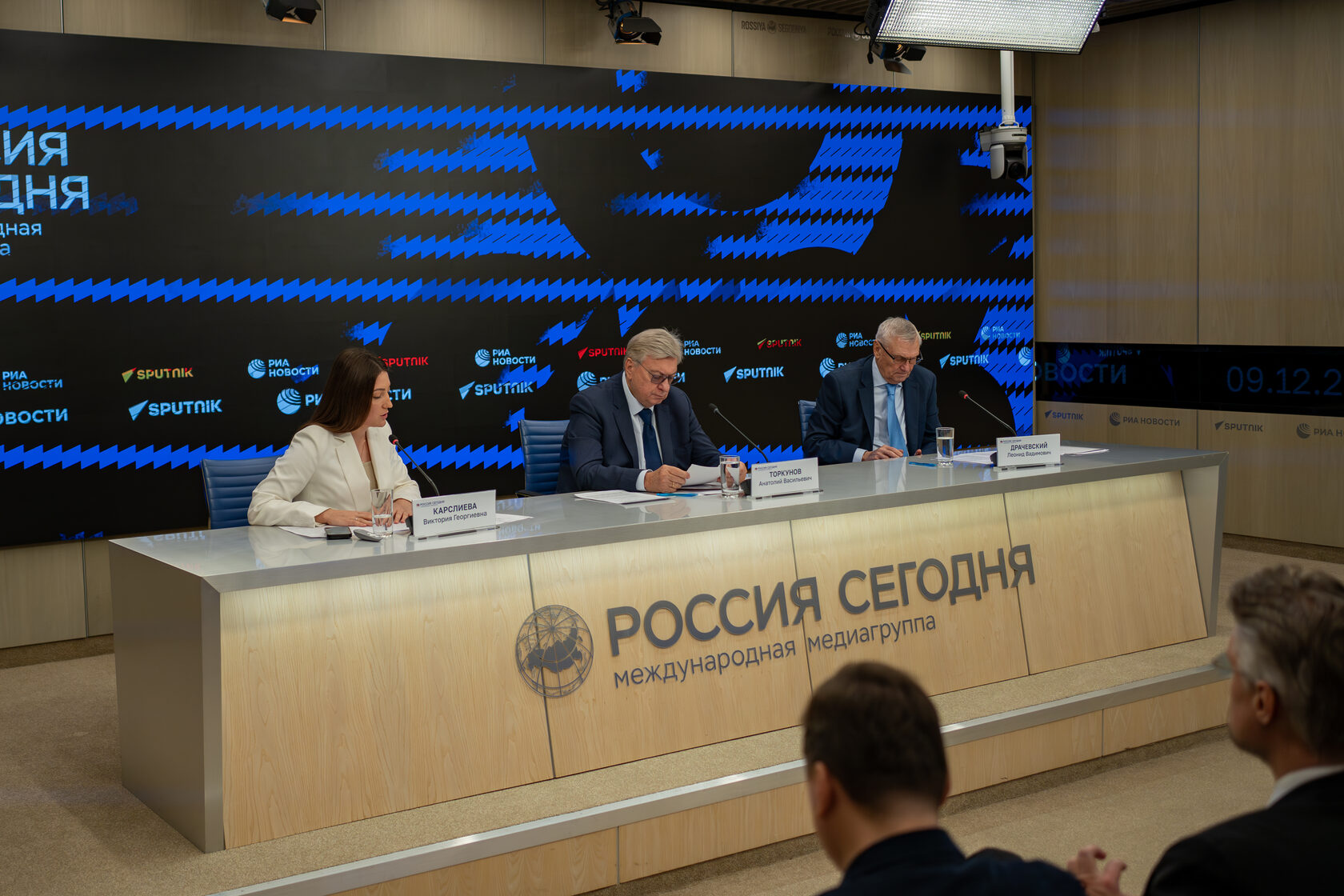
On December 9, Moscow hosted a press conference titled “Expert Dialogue in a Emerging Multipolar World.” Participants examined how the fragmentation of global order affects humanitarian policy and the efforts to expand international cooperation across various fields. Particular attention was brought to how Russian institutions and organizations are responding to these challenges as they work to strengthen their presence on global platforms and expand international collaboration. Speakers analyzed strategies and measures aimed at increasing the effectiveness of Russian diplomacy, science, business, and culture internationally.
One of the key items on the agenda was the review of the InteRussia fellowship program's 2025 results. The program is one of the leading initiatives aimed at shaping a new format of professional cooperation between Russia and international experts and specialists All speakers emphasized the importance of such initiatives in building long-term partnerships, facilitating exchange of experience, and developing new forms of collaboration — a task especially relevant in a time of geopolitical instability and global transformation.
Leonid Drachevsky, Executive Director of the Gorchakov Fund, spoke about the history of the program and its current scale.
“The task of public diplomacy is to create an environment where people would be able and would want to speak up — where they are listened to and heard. In an environment like this, you can always find common approaches and shared viewpoints. The Fund has always adhered to this principle and continues to do so. That is exactly why we created this program.”
MGIMO Rector Anatoly Torkunov discussed the key parameters of the modern world order, and analyzed the effectiveness of the fellowship program as a tool of humanitarian policy.
“As part of the program, MGIMO University has hosted fellows from more than 35 countries. InteRussia brings together people from all over the world. The program not only creates the right conditions for getting to know the country but also serves as an important opportunity to understand, analyze, and even document certain things in their research, which the fellows are working on in collaboration with their academic advisors—leading MGIMO specialists."
Discussions also included Dmitry Polikanov, Deputy Head of Rossotrudnichestvo; Vasily Pushkov, Director for International Cooperation at Rossiya Segodnya International Information Agency; Grigory Zaslavsky, Rector of the Russian Institute of Theatre Arts (GITIS); Alexander Safonov, Senior Vice President for Development at the Skolkovo Institute of Science and Technology; Dina Gorbatova, Vice-Rector of the Pushkin State Russian Language Institute; Andrei Berezovikov, Deputy Director General for Project Development of the World Youth Festival Directorate; Zhanna Tolstikova, Director General of TV BRICS; Dmitry Vasilenko, Vice-Rector for International Affairs at St. Petersburg State University of Economics; Vasily Kuznetsov, Deputy Director of the Institute of Oriental Studies of the Russian Academy of Sciences; and Ruslan Emirveliev, Head of the International Cooperation Department at Sechenov University.
During the discussion, speakers exchanged views and formulated recommendations for the further development of Russia’s international cooperation across various areas in the context of today’s global environment.
In 2025, the program featured 17 fellowships across seven professional fields. On average, the competition was 11 applicants per spot. More than 60 percent of participants had never visited Russia before, making the program their first personal experience with the country. The average age of the fellows is 30 years old; they are experienced specialists who have consciously chosen Russia for their professional growth.
The InteRussia Fellowship Program is implemented by ANO “Mezhdunarodniki” in collaboration with the Alexander Gorchakov Public Diplomacy Fund and partners, with support from the Presidential Grants Foundation, Rossotrudnichestvo as part of the “New Generation” program, the World Youth Festival Directorate, and ABS Electro.
One of the key items on the agenda was the review of the InteRussia fellowship program's 2025 results. The program is one of the leading initiatives aimed at shaping a new format of professional cooperation between Russia and international experts and specialists All speakers emphasized the importance of such initiatives in building long-term partnerships, facilitating exchange of experience, and developing new forms of collaboration — a task especially relevant in a time of geopolitical instability and global transformation.
Leonid Drachevsky, Executive Director of the Gorchakov Fund, spoke about the history of the program and its current scale.
“The task of public diplomacy is to create an environment where people would be able and would want to speak up — where they are listened to and heard. In an environment like this, you can always find common approaches and shared viewpoints. The Fund has always adhered to this principle and continues to do so. That is exactly why we created this program.”
MGIMO Rector Anatoly Torkunov discussed the key parameters of the modern world order, and analyzed the effectiveness of the fellowship program as a tool of humanitarian policy.
“As part of the program, MGIMO University has hosted fellows from more than 35 countries. InteRussia brings together people from all over the world. The program not only creates the right conditions for getting to know the country but also serves as an important opportunity to understand, analyze, and even document certain things in their research, which the fellows are working on in collaboration with their academic advisors—leading MGIMO specialists."
Discussions also included Dmitry Polikanov, Deputy Head of Rossotrudnichestvo; Vasily Pushkov, Director for International Cooperation at Rossiya Segodnya International Information Agency; Grigory Zaslavsky, Rector of the Russian Institute of Theatre Arts (GITIS); Alexander Safonov, Senior Vice President for Development at the Skolkovo Institute of Science and Technology; Dina Gorbatova, Vice-Rector of the Pushkin State Russian Language Institute; Andrei Berezovikov, Deputy Director General for Project Development of the World Youth Festival Directorate; Zhanna Tolstikova, Director General of TV BRICS; Dmitry Vasilenko, Vice-Rector for International Affairs at St. Petersburg State University of Economics; Vasily Kuznetsov, Deputy Director of the Institute of Oriental Studies of the Russian Academy of Sciences; and Ruslan Emirveliev, Head of the International Cooperation Department at Sechenov University.
During the discussion, speakers exchanged views and formulated recommendations for the further development of Russia’s international cooperation across various areas in the context of today’s global environment.
In 2025, the program featured 17 fellowships across seven professional fields. On average, the competition was 11 applicants per spot. More than 60 percent of participants had never visited Russia before, making the program their first personal experience with the country. The average age of the fellows is 30 years old; they are experienced specialists who have consciously chosen Russia for their professional growth.
The InteRussia Fellowship Program is implemented by ANO “Mezhdunarodniki” in collaboration with the Alexander Gorchakov Public Diplomacy Fund and partners, with support from the Presidential Grants Foundation, Rossotrudnichestvo as part of the “New Generation” program, the World Youth Festival Directorate, and ABS Electro.
